
Mitigating Transition Risks: A Strangler Fig Blueprint for Migrating to Veeva Vault CRM
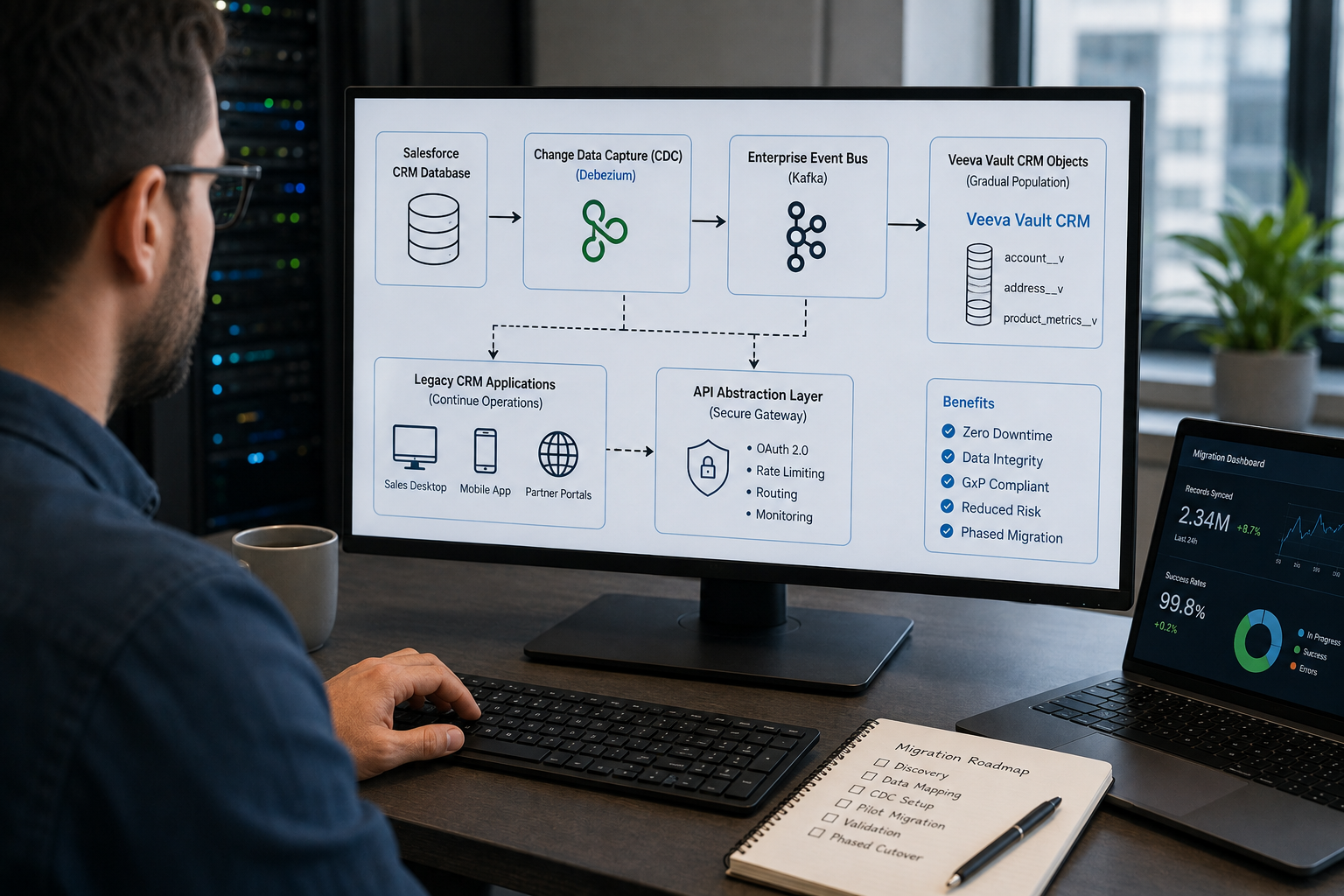
For Chief Information Officers (CIOs), Enterprise Architects, and Database Operations Directors in the pharmaceutical sector, customer relationship management (CRM) infrastructure is undergoing an unprecedented structural transition. The life sciences sector is navigating a high-stakes, industry-wide migration away from legacy, Salesforce-dependent CRM environments toward cloud-native architectures built directly on the Veeva Vault Platform (Veeva Vault CRM).
Because the commercial CRM platform functions as the central system of record for sales territory mapping, direct physical sampling data (Sample_Transaction_vod), medical inquiry tracking, and spend-transparency compliance records, execution errors during transition phases carry severe risks. A poorly orchestrated cutover can break validated data pipelines, freeze field sales operations, corrupt customer identity graphs, and trigger data non-compliance.
To eliminate migration risks without disrupting field teams or causing compliance vulnerabilities, life sciences IT departments must abandon old, all-at-once "Big-Bang" database cutovers. Platform architects should execute a phased software engineering roadmap based on the Strangler Fig Migration Pattern, leveraging decoupled API abstraction gateways, Change Data Capture (CDC) logs, and continuous data reconciliation pipelines.
The Migration Hazard: The Fallacy of the Weekend Database Switch
The traditional method for enterprise software migration relies on a high-risk timeline: attempting to migrate millions of complex customer rows, execute schema transformations, and switch thousands of global users over to a new system over a single weekend. In a standard enterprise cloud environment, a migration delay is an inconvenience; in a GxP-validated life sciences infrastructure, it represents an immediate compliance liability.
A primary technical hazard of the Big-Bang strategy is the generation of data drift across multi-tier relational fields. During a direct system switch, custom migration scripts frequently run into data transformation regressions due to structural mapping conflicts between traditional Salesforce sObjects and the cloud-native Veeva Vault Object (VVO) standard schemas.
If transactional synchronization backlogs occur across highly regulated datasets - such as professional sample accountability logs or medical signatures - the system's audit trails break. Under FDA 21 CFR Part 11 protocols, any un-reconciled data gap or mismatch across systems of record invalidates the data integrity trail, exposing the organization to severe regulatory penalties and system re-validation failures during audits.
The Framework: The Phased CRM Abstraction and Migration Lifecycle
The Strangler Fig pattern eliminates migration failures by gradually deprecating legacy interfaces piece by piece. Instead of forcing an all-at-once database switch, architects insert an independent API abstraction gateway layer using OAuth 2.0 scoping rules between the backend data cores and front-end user applications.
By leveraging Change Data Capture (CDC) tools like Debezium, core transactions are read directly from the database storage logs and streamed into an append-only event bus (such as Apache Kafka). Rather than hitting REST burst boundaries, these events are compiled into batched payloads and pushed asynchronously via the Veeva Vault Bulk Object API, safely populating the modern Veeva Vault architecture without placing a direct load on active commercial channels:
| Migration Parameter | Traditional Big-Bang Cutover | Phased Strangler Migration Pattern |
| System Downtime | High risk of multi-day field sales access outages. | Zero Downtime: Progressive, background system cutovers. |
| Data Ingestion Mode | Synchronous, high-volume batch loading. | Asynchronous, batch-optimized event stream execution. |
| API Architecture | Brittle point-to-point data mapping scripts. | Decoupled abstraction using Veeva Vault Bulk APIs. |
| GxP Validation Scope | Complex, enterprise-wide system re-certification. | Isolated, micro-segmented verification checks. |
Technical Implementation Blueprint for Infrastructure Engineers
To build and scale a GxP-compliant, zero-downtime migration pipeline to Veeva Vault CRM, database and platform engineers should deploy four core structural configurations:
Step 1: Configure an API Gateway Abstraction Layer over Core Registries
Establish a secure API gateway between your existing front-end user applications and underlying databases. Use specific data partitioning parameters to isolate core commercial data schemas, ensuring your modern query tools can pull records without making direct calls to brittle legacy storage systems.
Step 2: Deploy Log-Based Change Data Capture (CDC) Pipelines
Connect a non-invasive CDC tool directly to the transaction logs of your legacy CRM database. Pipe real-time record modifications - such as updates to account profiles, doctor specialties, or target metrics - directly into an append-only message bus, formatting data updates into lightweight JSON payloads to prevent transaction backlogs.
Step 3: Implement Idempotent Ingestion via Veeva Vault Bulk Object API
Configure your migration pipelines to utilize the Veeva Vault Bulk Object API endpoints rather than individual REST requests to avoid triggering HTTP 429 Rate Limit Errors. All record blocks must be compiled into multipart/form-data CSV chunking payloads containing up to 50,000 records per batch. Ensure that headers specify the exact external ID field parameters to execute an idempotent operation on target Vault objects - such as account__v, address__v, and product_metrics__v - preventing row duplication if a pipeline job undergoes a standard mid-transit restart.
/* Conceptual HTTP request header and CSV multi-part payload layout for an asynchronous Veeva Bulk Object API load */
POST /api/v26.0/vobjects/account__v/bulk HTTP/1.1
Host: ://veevavault.com
Authorization: Bearer 00D50000000I...
Content-Type: multipart/form-data; boundary=----VaultBoundary2026

------VaultBoundary2026
Content-Disposition: form-data; name="file"; filename="accounts.csv"
Content-Type: text/csv

id,npi_primary__v,first_name__v,last_name__v,credentials__v,status__v
,1029485761,Sarah,Jenkins,MD,active__v
------VaultBoundary2026--
Step 4: Execute a Phased Feature and User Group Cutover
Begin migrating data features incrementally, separating non-regulatory territory parameters from compliance-controlled records. Verify data ingestion continuity by executing granular delta scans using Vault Query Language (VQL). Once master profile tables successfully pass automated data validation checks across a pilot sales territory, update user interfaces to route that region's application traffic away from the legacy Salesforce backend over to the validated Veeva Vault CRM platform, slowly shrinking the old software footprint.
Conclusion: Modernization through Structural Discipline
Successfully modernizing your primary life sciences database requires rigorous architectural discipline rather than raw execution speed. Attempting to force an immediate, all-at-once software replacement across a multi-region commercial ecosystem introduces unacceptable regulatory risks, increases technical debt, and threatens business continuity.
Applying the Strangler Fig pattern within an event-driven framework allows pharmaceutical CIOs and enterprise architects to safely transition their most critical commercial system to modern cloud platforms like Veeva Vault CRM - maintaining flawless data integrity, ensuring absolute GxP compliance, and avoiding operational disruption to the field sales force.
About Author

More to Read
Your Regulatory Team will love us.

Requirement
Business Goal

Update
Implementation

Safety Check
Auto-validation

Audit Trail
Ready for Inspection
Requirement
Business Goal
Update
Implementation
Safety Check
Auto-validation
Audit Trail
Ready for Inspection